






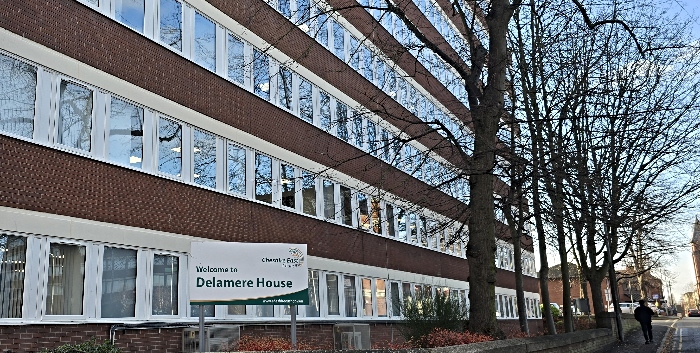
Cheshire East councillors have approved a 4.99% hike in council tax as part of a budget aiming to “put council finances on a sustainable footing in the long term”, writes Belinda Ryan.
But it was a close vote with the budget being voted through by only 40 to 38, with three councillors abstaining at full council yesterday (Feb 25th).
It will see the total annual council tax bill for a band D property go up to an average £2,454 from April.
The Labour/Independent run council has only been able to balance its books after being granted exceptional financial support (EFS) of £35 million from the government.
EFS enables councils to fund some day-to-day spending as longer term capital spending, which is usually funded through borrowing or selling assets.
Cheshire East is looking at using £24.995 million EFS to balance the shortfall for 2026/27.
Cllr Dawn Clark (Lab), chair of the finance sub-committee, said the budget was a combination of income, use of resources, robust saving plans, the proposed use of exceptional financial support and an increase in council tax of 4.99%.
“I consider the MTFS (medium term financial strategy) to be robust. We aim to eliminate reliance on exceptional financial support,” said the Crewe councillor.
“Our budget will deliver the best value services for our residents.
“We will not over promise, but continue to monitor.”
Deputy council leader Michael Gorman (Wilmslow, Ind) told the meeting: “Putting forward this budget, we set out a package of plans to protect essential services and work towards putting council finances on a sustainable footing in the long term.”
He said the plan included a range of savings and income growth proposals across services based on business cases.
“An example of that is reducing employer contributions to the pension fund from 23.7 per cent to 18 per cent with a saving of around a million pounds a year,” he said.
The deputy leader said he realised the increase in council tax would have an impact on household budgets but there was support for those on the lowest incomes.
He added: “We are the lowest council tax of our neighbours, for instance, in the unitary councils of Cheshire West and Cheshire and Warrington.”
The Conservative’s financial spokesperson, Cllr Chris O’Leary (Sutton), said the council had had to rely on EFS for the past three years to balance its books.
“The £25 million budget gap (for the 2026/27 financial year) is almost entirely explained by the failure of the administration’s transformation programme and the cost of dealing with the administration’s inadequate rating in children’s services,” he said.
The Conservatives put forward an alternative budget yesterday, which included increasing the vacancy rate at the council from the proposed 5% to 10%, reducing the members’ allowances budget and scrapping ward members’ budgets for local highways improvements a year early.
This was rejected with former deputy leader Craig Browne (Alderley Edge, Ind) criticising it as “a collection of statements for noting, rather than a genuine attempt at an alternative budget”.
Former council leader Sam Corcoran (Sandbach, Lab) branded it “a ragtag list”.
Conservative group deputy leader Liz Wardlaw (Odd Rode) said the amendment was made in good faith.
“It’s a positive contribution to the financial predicament of this council,” she said.
“Savings promised by the administration have failed to be achieved year on year.
“Savings made through transformation have been negligible to this point.
“Borrowing continues at high interest rates.
“All efforts to improve the situation for our residents and to reduce the financial burden on them should be welcomed.”








Dear NB
Career Average Pensions are still a form of Final Salary Pensions, based on a mathematical calculation as opposed to defined contribution which is a money purchase arrangement based on investment returns which cannot be guaranteed. Again a Local Government employee have over 20% of their basic incomes paid into the pension scheme by their employer. This is at least 15% more than in the private sector. Historically the public sector may have claimed there incomes were below the private sector. Based on job evaluation under accepted management practice this not the case today based on my research.
In reality the increase in Council Tax in recent years has far exceeded the rate of CPI or the average earning index.
I know of people who are retired who saved hard, financially prudent who are sadly considering that they may have to consider selling up and moving to a cheaper property.
This is in areas where the increase will be 9% from April this year
The multiplier and compound effect of increases on increases year on year.
Ask what your self ‘What you have to earn in gross income to pay your council tax?
Ask your self what this percentage was 10, 20 and 30 years ago.
I think you will be quite shocked !!!
Middle England is getting squeezed sadly!!!
Some mug has to pay for the Crewe £11M White Elephant Multi-Storey Carpark and the wholly unnecessary out of town grandiose Police Station costing £16M plus and rising?….Suck it up Ratepayers!
Some of the claims in this comment section regarding public sector pay and pensions are factually incorrect.
1. Local government pensions are no longer “final salary.” The Local Government Pension Scheme (LGPS) was reformed over a decade ago. Since April 2014, it has been a Career Average Revalued Earnings (CARE) scheme. Additionally, high employer contribution rates (like 23.7%) do not solely fund current workers’ benefits; a large portion goes toward paying down historical deficits in the pension fund that accrued decades ago.
2. Evidence comparing public and private sector pay absolutely exists. It is false to claim there is “no evidence.” Independent bodies like the Office for National Statistics (ONS) and the Institute for Fiscal Studies (IFS) publish extensive data on this. While simple averages skew higher because local government has fewer minimum-wage roles, statistical comparisons show a different reality. When workers are matched by age, education, and exact job type, the evidence consistently proves that highly skilled public sector professionals generally earn less than their direct private sector equivalents.
If we are going to debate council spending and value for money, the discussion needs to be based on accurate information.
As they wanted 10% but were turned down by the government they were always going to go as high as they legally could,shame my income does not rise as quickly as these idiots waste my money
Just perused the report to increase Council Tax by 4.99%. It has a lot of words. There are several interesting sections and I suggest readers visit CEC web site. They say that there has been public consultation into a rise and looking at para 1.210 it reveals some interesting information eg
2248 responses with 336 responses to a follow up
11 Budget Engagement sessions with 353 attendees
2 Community Assemblies 29 attended
1977 social media comments.
Over 50% opposed the increase, 30% supported. Does this mean those opposing could have been some 70%?
It is evident CEC needs to improve its consultation with tax payers and not hide behind its web site etc. Of this idea there is no comment.
CEC never delivers on what it promises.
To the deputy leader……..Support is always given to households on lowest incomes, YET households on modest incomes, just above CEC/Government thresholds, are struggling and receive no support whatsoever. BULLOCKS to you deputy leader.
Year on year, CEC are inept at balancing the books, have hairbrained ideas and monsterous carbuncles.
Cheshire East Council has wasted millions of pounds of tax payers money. The evidence is out there to prove it.
Sadly it fails to deliver value for money and perceives the council tax payer as a cash cow to support it continued incompetence.
The tax payer is paying 23.7 % of basic salary costs in the their final salary pensions. In the private sector your employer would pay about 3 %
Why should the tax payer be expected to support public sector pensions which have a total liability of 2.6 trillion pounds.
It is no good saying the public sector employee earns less than their equivalent in the private sector based on job evaluation. There is no evidence to support such a claim.
Plans to reorganise Local Authorities will increase the burden on the tax payer. The Directors will claim they need bigger incomes, followed by totally unaffordable pensions to the tax payer.
We need a Government who will get to grips with failure which prevails in the public sector.
There is always an excuse, we lack funding. This is due to cut backs following the Financial Crisis.
There is a failure to measure outcomes and results.
I know of people who are retired now questioning their ability to continue to maintain financial stability to remain in their current homes due to the increases in council tax and the overall percentage of income taken by this pernicious tax.
These are people who have worked hard all their working lives, saved hard been prudent and careful.
Those people outside the benefits system and pension credit. Middle income Britain is being squeezed to pay for incompetence.
Borrowing is not at high interest rates, I remember 14% mortgage rates.
Savers suffer when rates drop. Historically since the financial crisis interest rates have remained low.