







Wondering why two quotes for the same app differ by thousands of dollars?
Before you sign anything, hire react native developer talent only after you understand what actually drives the price tag.
Rates swing wildly across the globe.
A senior engineer in one region charges triple what a peer charges elsewhere for nearly identical work. The trick is knowing which factors move the number and which ones quietly inflate your bill.
Cost is rarely about a single hourly figure. It bundles seniority, location, engagement model and the hidden overhead of managing the whole thing. Miss one of those and your budget drifts fast.
What Actually Shapes the Price
Think of hiring like buying a car. The sticker price is one thing. Insurance, fuel and maintenance are another story entirely. Developer cost works the same way.
Several levers push the rate up or down.
● Seniority level of the engineer
● Geographic region of the talent
● Engagement model you choose
● Project complexity and native integrations
● Duration of the contract
Each lever matters on its own. Stack them together and you see why a quick freelance patch and a long enterprise build live in different financial universes.
Seniority Changes Everything
A junior developer looks cheap on paper. The hourly rate tempts tight budgets. Yet juniors need oversight, write more bugs and lean on senior colleagues for tricky native code.
That supervision is a cost too, just hidden in someone else’s calendar.
Senior engineers cost more per hour and save money over the project. They ship cleaner code, solve problems without hand-holding and cut the bug fixing cycle that drains weeks.
When the work involves payments or compliance, that independence pays for itself.
Region by Region Rate Ranges
Location remains the loudest factor in any quote. Here is a rough snapshot of typical hourly ranges for experienced React Native developers across major hiring regions.
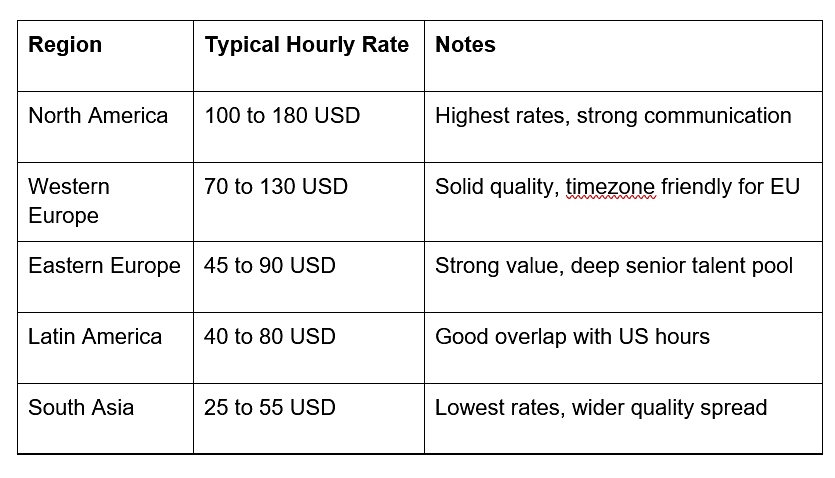
These bands shift with demand and experience. Treat them as a compass rather than a fixed map.
Engagement Models and Their Cost Logic
How you hire reshapes the math. A freelancer bills by the hour with little overhead.
A managed team folds in vetting, project management and quality assurance which raises the visible rate while lowering your own time spent firefighting.
Three common models cover most needs.
1. Freelance contractor for short scoped tasks
2. Staff augmentation to plug skill gaps in an existing team
3. Dedicated team or full project delivery for long builds
Picking the wrong model is like renting a moving truck for a single grocery run. Match the model to the job and the spend suddenly makes sense.
The Hidden Costs Nobody Quotes
Here is what rarely appears in a proposal. Recruiting fees. Bench time between projects. Onboarding hours. The cost of a wrong hire who needs replacing two months in.
Andersen addresses part of this by keeping a bench of more than 120 pre vetted React Native developers, with roughly 80 percent at senior or mid-level and over five years of mobile experience.
When you hire through a staffing partner, you skip recruiting fees and bench costs while gaining engineers ready in two to four weeks. That shaves both time and a layer of risk off the budget.
Complexity Drives the Final Number
A simple app with basic screens costs a fraction of a fintech platform packed with native modules. Why? Because complexity multiplies the hours and demands rarer skills.
Features like biometric login, encrypted storage, offline mode and third party integrations each add engineering time.
The more native code the project touches, the higher the seniority you need and the steeper the rate climbs.
How to Keep Costs Under Control
So how do you avoid overpaying? Start with clarity. A vague brief invites padded estimates and scope creep.
Lock down requirements early. Choose a region that balances rate and communication. Favor senior engineers for complex work since their speed offsets the higher hourly cost.
Lean on a vetted partner to dodge recruiting overhead and slow hiring cycles.
Conclusion
The real cost of hiring experienced React Native developers is never just an hourly rate. It is seniority plus location plus model plus the quiet overhead most quotes leave out.
A cheap junior in a low-rate region can end up pricier than a senior who ships clean code in half the time.
For long cross platform builds where consistency matters, Andersen offers pre-vetted senior engineers ready in weeks, helping you trim recruiting fees and start without delay.
Map your own priorities first, then the spending choice grows clear.
FAQ
Is a lower hourly rate always the cheaper choice in the end?
Rarely. A budget junior often needs more oversight and ships more bugs, which quietly adds hours and pushes the true total above a faster senior hire.
Do React Native developers cost less than separate iOS and Android teams?
Usually yes. One codebase serves both platforms, so you fund a single team instead of two, which trims per-platform cost and shortens fix cycles.
Why does the same project get quotes that differ by thousands?
Region and seniority drive most of the gap. A North American senior can bill triple an Eastern European peer for nearly identical output.
What surprise costs should I budget for beyond the rate?
Recruiting fees, onboarding hours, bench time and the price of replacing a wrong hire. Pre-vetted partners fold many of these into one predictable rate.
How fast can I start without inflating the cost through delays?
A staffing partner with a ready bench places engineers in two to four weeks, sparing you a long recruitment cycle that burns both time and money.









Recent Comments