






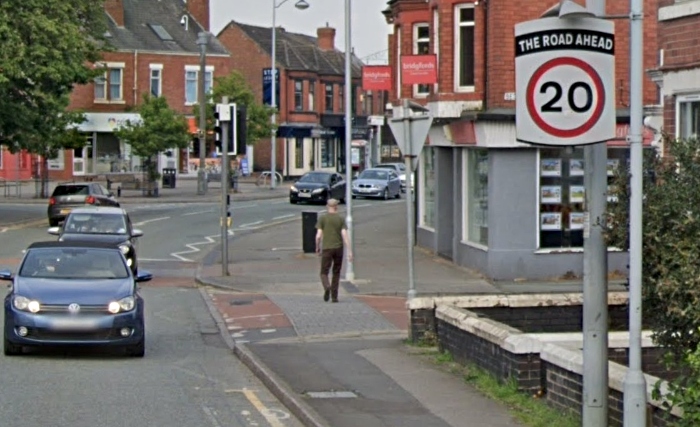
Residents have urged Cheshire East to consider introducing a 20mph speed limit on restricted roads across the borough and asked why it isn’t included in the draft active travel strategy.
The call came at a meeting of the highways and transport committee where councillors were discussing the draft strategy and local cycling, walking and infrastructure plans.
Resident Tim Meluish told the committee: “Concerns over road danger and fear of collisions are the most common barriers to cycling.
“Furthermore, the speed at which people drive impacts the likelihood and severity of the outcome of a collision.
“People walking who are hit by a vehicle at 30 miles an hour are around five times more likely to be killed than at 20 miles an hour.”
Mr Meluish said he estimated, based on the cost of the Wales 20mph scheme, it would cost Cheshire East about £10 million to do the same across the borough.
“In other words, for just one tenth of the cost of one bypass, the majority of residents across the whole borough would benefit,” he said.
He added that adopting a default 20mph limit would be cheaper and less disruptive than constructing segregated cycle lanes.
John Knight, of the Green Party, said: “While reduction of the default speed limit from 30 to 20 would have very little effect on journey times, it would be a massive improvement in the safety for non-motorised road users.”
He added: “Even after the previous government’s vehement opposition to these reduced speed limits, 20 is plenty, two thirds of residents in central Macclesfield would still like to see this put in place.”
Tom Moody, director of transport and infrastructure, said the council adopted a speed management strategy about two and half years ago.
“The decision that was resolved by this committee was to implement a case-by-case approach, an area-by-area approach, which considers a number of factors within those areas, which will potentially determine whether or not a reduction in the speed limit is required,” said Mr Moody.
“The strategy does not, in itself, adopt a unilateral approach to 20mph speed limits across the borough.”
Committee chair Mark Goldsmith (Wilmslow, Ind) said while he understood the sentiment of the public speakers ‘currently, we do not have £10 million in reserves at all’.
“We have almost no reserves at all,” he said. “So while it is a very small sum of money in the scheme of things, and to central government, for us at the moment, that’s a huge amount of money.”
(Story by Belinda Ryan, local democracy reporter)









I spent 20 years coaching individuals to pass their Advance Driving Test with the Institute of Advanced Drivers. The speed limit was never a target, speed should always be appropriate to degree of threat and hazard and speed should always be in the speed limit. Sadly a number of drivers, riders just ignore the speed limit. Walk down the Barony Road in Nantwich. It does not take long to see the evidence. Drink driving, drugs and driving and poor attitude to fellow human beings are also major factors. I agree with 20 mph speed limits if it is appropriate schools , estate roads . However blanket 20mph as was carried out in Wales has been reflected upon and some have rightly been returned to 30 mph.. Enforcement of 30 mph speed limits might be a start. I rarely see any form of enforcement on the Barony Road. Can some tell me how many road deaths or serious injuries have there been in 30 mph limits in Cheshire East. A good road safety measure if applied appropriately with common sense. Establish a criteria for the 20 mph limit, schools, estate roads. Sainsbury’s in Nantwich has 5 mph limit, on occasions you would think it Silverstone or Oulton Park.
Developing drivers observation, hazard perception and hazard management skills would also assist in reducing incidents and collisions.
@ Jem
regarding your balance of risk approach
You forget to mention that 50 years ago, no sat navs, no Spotify, no mobile phones existed, and drivers were far less distracted behind the wheel than they are now.
Also, some cars weren’t also in excess of 2 tons by weight, due to car dimensions that have increased in size, and become stronger and heavier as a result. Some car models have doubled in weight since their previous counterparts were introduced in the 20th C.
So whilst car safety might have improved, that doesn’t directly translate to safety for more vulnerable road users due to all of the above.
A reduction of speed in built up areas is a good idea that should be examined, debated and then decisions made when the evidence has been gathered.
Maybe if everyone is so frustrated by a proposed reduction from 30 to 20 mph, that has proven evidence it saves lives, they should consider alternative forms of transport instead. So many unnecessary journeys being made which could be made on foot or bike instead.
Ridiculous
Non-sensical
Incompetent government
Moronic
Those are the words being used on this thread.
Try telling the family of someone who has been killed or injured by a speeding driver that its any of those words
And dont say its a balance of risk – only today (June 24) the police in Nantwich area recorded speeds of up to 43mph in a 30mph zone.
Thats why a change is needed, and yes the minority always do ruin things for the majority but if 1 life is saved due to the change, its worth it.
With all the pot holes you struggle to do twenty anyway,think they are the new speed humps.
More people including cyclists injured by having to avoid these holes
The Green Party are wrong to state reducing 30 to 20mph will have little effect on journey times. I regularly travel through Wales and the 20mph is ridiculous and slows traffic to crawling pace in built up areas and in rural areas it is nonsensical. Cannot imagine the congestion this would cause in built up traffic areas throughout CEC at 20mph. Would be better introducing speed cameras and eventually idiot drivers who ignore speed limits, get fined and will feel it in their pockets and maybe educate themselves. There is hope!!!
Pips, I think you miss my point. Of course the lower you go, the fewer accidents. Maybe we should revert to a 4mph limit with a red flag carrier in front; that would really help. We could reduce motorway limits to 30, or make it illegal to cross the road except at a lighted crossing. How about banning motorbikes, as they have the worst accident statistics and lowest survival rates. Ban alcohol too, that would stop hundreds of thousands of assaults
We have to live our lives as a balance of risk, benefit and social freedoms, and with modern vehicle safety (including drastically improved pedestrian impact protection) a 20mph limit is simply too slow.
We are massively safer, both in the car and walking than 50 years ago. How much inconvenience and frustration should we accept in the drive to zero accidents?
Its always worth checking out the facts before you criticise something. Take your pick.
https://www.gov.wales/safest-summer-welsh-roads-new-statistics-show
https://www.bbc.co.uk/news/articles/c78w1891z03o
Yes, and you could reduce injuries to near-zero by imposing 5mph speed limits.
According to gov.uk, in 1979 there were 15 million cars and 6,000 road deaths. In 2023 there were 33 million cars and 1,600 deaths, so twice the number of cars and one sixth the deaths.
Take away the casualties due to negligence, diver error, drink, drugs weather, vehicle condition etc., and motoring is hugely safer than fifty years ago.
20 mph is an absolutely ridiculous limit, and not only is it not necessary, it’s yet one more example of incompetent government control.
Utterly moronic idea……good job CE can’t afford it !
No No No No…
How about saving £10 million and drivers just slow down everywhere, some drivers are quite callous to pedestrians and cycles, I have had several run ins on Snow Hill car park, it’s used as a rat run, and there are no pavements totally thick drivers are to blame, we need a thicko tax on them