








Cash-strapped Cheshire East Council is applying to the government for permission to increase council tax by up to 9.99% this year, writes Belinda Ryan.
The council is looking at a funding a massive gap of £18.2 million for the 2026/27 financial year.
In December, officers wrote to the government requesting exceptional financial support (EFS) to help balance the books, including being allowed to hike up council tax by up to 9.99%.
A report to this week’s meeting of the finance sub-committee states: “The section 151 officer (finance boss) is clear that the scale and challenge faced by the council is such that it has no choice but to consider both capitalisation directions and council tax flexibility as tools to support the route to financial stability.
“Council tax flexibility at 9.99% will add more than £15 million to the base income, whereby every 1% on council tax equates to more than £3 million of additional income.
“As such, it is the professional advice of the section 151 officer that the council’s EFS request be both capitalisation and council tax flexibility up to 9.99% and the ongoing dialogue with MHCLG (ministry of housing, communities and local government) has been to that effect.”
An increase of 4.99% – the usual maximum a council can impose without a referendum – would see Cheshire East’s part of the council tax rise from the current £1,882.04 to £1,975.95 a year for a band D property.
If it went up by 9.99%, that figure for a band D property would be £2,070.06.
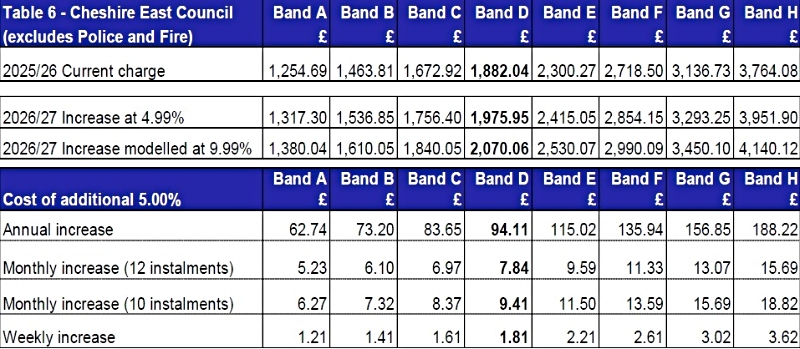
These figures relate just to the Cheshire East part of the bill and do not include proposed rises for the police, fire and rescue service and town/parish council precepts.
Last year, the government refused Cheshire East’s request for permission to increase council by up to 9.99%.
The report from the council officers states no decision has yet been taken on the council tax increase – the recommendation for the whopping rise is “professional advice”.
It adds: “A decision on any flexibility on council tax resides with ministers in the first instance as to whether it is approved by MHCLG.
“Should it be granted, it is the responsibility of elected members to decide whether to accept the council tax flexibility option and increase the levels above the referendum levels. It is not a decision for the section 151 officer.”
The finance sub-committee meeting takes place at 10am on Friday January 30th at Delamere House in Crewe.
A final decision on the council tax increase will be taken by full council at its budget meeting in February and will be dependent on whether it is given permission by MHCLG to raise it above the current referendum thresholds.







Watching the Daily Politics on BBC 2 at 12.15pm is very informative. In recent weeks one of the guest’s was a Chief Executive of a major UK Company. he made very astute observations re the culture in the Public Sector.
Spending more money was not the answer to all problems. Outcomes were not not effectively measured and analysed. Hie example was very clear , a child in care costs £250,000 to £340,000 a year to the tax payer.
The outcome are that 20% to 25 % will eventually culminate in being sent to prison.
He challenged the MP to ask if this was perceived as a success.
You can a child to the best private or public school for a fraction of this cost.
Until the public sector measure and analyse outcomes, look at new processes , protocols and procedures and think outside the box they will continue to demand more and more taxes and deliver less and less.
There is no justification to consider raising the Council Tax by nearly 10% There is an arrogance within the whole culture of Local Authorities that the citizens are a Cash Cow.
They should start with the premise that its is tax payers they are spending, how should they spend it prudently delivering value to the tax payer.
I have no doubt the current Chief Executive of Cheshire East who I believe is on sick leave is still in receipt of his full salary for a period of 6 months, then half pay for a further 6 months.
My plea is to stop wasting money. There are a number of published issues that support these comments.
#CreweFirst says, “Labour Government should not allow Labour run Cheshire East to increase their Council Tax by a whopping (almost) 10%.
@CheshireEast tried to increase by 10% last year and it was rejected.
Why haven’t the other opposition political parties in #CheshireEast followed the lead of #CreweFirst and come out against the 10% increase?
What are they afraid of?
Why are they always so weak?
If the 10% increase is rejected by Government #CheshireEast could try and get it through by holding a binding referendum……..but they won’t do that because they know the result would be overwhelmingly against the huge increase in Council Tax.”
Here are the rules :-
Upper tier Councils like #CheshireEast CANNOT increase their Council Tax by more than 5% unless :-
a) Hold a local referendum — The Council proposes the higher increase, runs a binding public vote, and only implements it if a majority votes yes.
b) Government grants exceptional flexibility.
https://thenantwichnews.co.uk/2026/01/27/cheshire-east-to-seek-9-99-rise-in-council-tax-in-2026-27/
Comparison to National Average: In 2025-26, the average Band D property cost in England is projected to be around £2,280, reflecting significant increases nationally. Cheshire East’s core Council Tax (pre-parish) has risen steadily, but total bills often include higher-than-average town and parish council precepts (e.g., in 2024/25, total band D in some areas surpassed £2,200).
Cheshire East Council spends more than 60% of its net budget on adult and children’s social care services. This high demand, driven by an ageing population. Budget allocation is almost 70p in every £1 of council tax and is directed toward supporting vulnerable adults, children, and elderly residents.
The figures quoted in the Band Table, do not include Fire, Police and Parish Councils portions, so the CEC table needs revising to be more reflective and include all fees being paid under CEC rates.
Also, it only gives figures for an increase of 5%, thus making it look like you are only paying a pittance more over the year, per 12 months, per 10 months or per day. DOUBLE those figures for a 9.99% increase, which is what CEC are wanting for period 2025/2026 and it then sets the precedent for the same 9.99% increase, if not more for following years.
My house banding is C and for 2025/2026 period, my figures are CEC 1672.92 (5% ); Parish Council £34.55 (108.5%); Fire £84.52 (5.5%) and PCC £246.17 (5.3%) – Total: £2038.16……………FAR CRY FROM THE TABLE SHOWING OF £1672.92.
On top of those figures, the green bin collection has gone up from £59.00 to £69.00, a further £10 increase for 2026.
We will have to wait and see if Labour Government allow this 9.99% increase and DON’T FORGET, Crewe is going for devolution, so we will have new Mayoral fees to be added to our rates.
People who pay their rates in full, shouldn’t be penalised for those not paying their rates in full. We all have to struggle and live to our means, and as a pensioner I know how hard that is, without any financial assistance whatsoever and paying tax on my pension. It isn’t just the rates getting hiked: Household insurance, green bin collection, water rates, food…the list is ongoing.
Do cec pay for the immigrants in the hotels, why , after a massive donation from the government are there many potholes, tbf,, I’m withholding my c/tax this yr until I get to spend a couple of weeks within the cec depts to see where the money is going, it doesn’t balance?
Indeed rather misleading Band table, as those figures do not include Police, Fire and Parish council charges and it would have been realistic if CEC had included within that table the additional fees rate payers are charged, so that it was more reflective information, rather than omit the charges for Police, Fire and Parish councils.
I’m in Band C and my total for 2025/2026 period, per 10 monthly payments, is £2038.16, so far cry from the £1672.92 being shown in the table. For period 2025/2026 Band C, percentage increases WERE CEC 5%, Parish 108.5%, Fire 5.5% and Police 5.3%.
So rest assured, your rates (Band C) will just not be £1756.40 (4.99%) or £1840.05 (9.99%), they will be way over £2K and having to pay an additional £65 to have garden waste collected (a £10.00 increase on that).
Further insulting, CEC giving what figures would increase per year, per 12 months, per 10 months, per day………..BASED ON A 5% INCREASE, but do not Double those figures for 9.99%.
JUST TRYING TO MANIPULATE THE FIGURES IN A TALBE TO MAKE THEM LOOK BETTER.
Don’t forget that there will be others taxes to pay along with your CEC tax. This extra cost covers Parish/Town Councils, Cheshire Fire Authority and PCC for Cheshire Police. CFA increase 2025/26 5.6% and PCC 5.3%.
Hello Ian
I read your lengthy responses as if they are well thought out comments on CE Council.
However, all the noise on this website, whilst makes interesting reading, does not make a difference. Perhaps your comments would be better directed at the CEO’s office or at Westminster?
If we are all to make a difference. We need to direct our enthusiasm in the right direction and not on here at the office gofer.
As harsh as this may sound, CE council or Westminster decision makers, are not obliged to to listen to our views via this format.
Beryl
IH, I appreciate you sharing your sources. You are absolutely right about the Crewe Car Park—that is a undeniable ‘white elephant’ and a valid example of poor capital investment. I also agree that the £11m spent on HS2 preparation is painful to see wasted, though I would argue that was money spent in good faith on a Government promise that Westminster broke, not Cheshire East staff.
However, your figures on the workforce and pensions need a significant correction:
Your claim that 25% of our money goes to pensions is incorrect. While the employer contribution rate on a salary might be 20%, that is only a percentage of the staff wage bill, not the total Council budget. In reality, independent analysis (UNISON/LGA) shows that only around 5% of your Council Tax bill actually goes towards the Local Government Pension Scheme. The vast majority goes to services. Furthermore, unlike the NHS or Civil Service, the Local Government pension is a funded scheme (invested in assets), not a direct drain on the taxpayer like the unfunded liabilities you mention.
Flexi-time does not grant ’12 days additional leave.’ It is a zero-sum system. If a staff member takes a flexi-day, they have already worked those extra hours unpaid in the weeks prior. It actually saves the taxpayer money, because without it, the Council would have to pay expensive overtime rates for evening meetings and emergency work.
You ask why the Council can’t operate like the private sector. The answer is simple: The private sector ignores ‘unprofitable’ business. If a customer can’t pay, a private business stops serving them.
The Council cannot do that. We cannot refuse to collect a bankrupt person’s bin or refuse to house a penniless elderly resident because they have ‘bad credit.’
The ‘Council Tax Arrears’ you mention are largely from people who physically cannot pay. A private business would write that debt off; the Council keeps it on the books, but no amount of ‘efficiency’ can extract blood from a stone.
We can agree that the Car Park is a mess, but attacking the staff who are trying to deliver statutory care on a shoestring budget doesn’t solve the funding crisis
About time people started to realise what a mess the Tories left with their continual cutbacks to Local Authorities. Labour can’t sort it over night so if people want decent services it’s time they actually paid towards them. CEC bands are relatively small compared to other councils
Dear Not Blinkered
Yes I can have some empathy with your remarks. However lets get real, One in four pounds goes towards the gold plated pensions of local government employees. Gordon Brown ensured the demise of final salaries in the private sector. The cost is 20% to 25% of basic pension salaries to the tax payer. Public sector liability for pensions is around 2.6 trillion pounds in total, based on my research.
Flexi time enabling additional 12 days annual leave a year.
My experience in the private sectors and my family who continue in that environment involves work beyond contractual hours unpaid.
Outcomes and results are key performance indicators. The private sector is driven by outcomes, not just talk and attending meetings to look busy, busy.
11 million pounds spent on a multi story car park, running costs £70,000 per annum revenue generated £20,000 approx. No investor in the private sector would accept these figures as a viable business plan.
10 Million on consultants for HS2.
Money is wasted on projects that do not benefit the citizens.
Add up the monies wasted. It is huge.
Very high salaries paid for little value to the tax payer.
A distinct lack of performance management.
Pot holes poorly repaired , requiring repairs every few months.
The list goes on.
Please I have worked as a senior manager in the Private Sector.
Another example the level of sick leave within the Public Sector, It would not be tolerated in the Private Sector. These figures were published in Nantwich News last year.
It is a about being effective, working to the SMARTER Principle, accountability and responsibility.
Sadly that means capability proceedings for non performers.
Ask how many people in Cheshire East who take advantage of generous sick leave.
There is room for cost savings.
If they are so good why not publish the results.
There is a very distinct cultural difference in management.
It will never change until those at the top are replaced by individuals who can drive change, deliver the tax payer value.
Council Tax Arrears in Cheshire East Council, a subject ignored. It costing us honest tax payers a huge amount of money.
My research would suggest if all arrears were paid up to date there would be no black hole this year.
Sir I am very happy for you to provide me with evidence that refutes my comments.
I am open minded.
I do however over time gather my evidence from reliable sources.
Pedro. Saying this is just down to ‘bad negotiators’ simplifies a national crisis into a soundbite. The reality is much starker.
Even the best negotiator in the world cannot force a private care provider to operate at a loss. The ‘efficiency’ of the private sector you praise is exactly why costs are skyrocketing: private companies know the Council has a legal statutory duty to house vulnerable people. If the Council refuses to pay the requested rate, the private provider simply refuses the contract. The Council is then forced to pay even higher ’emergency rates’ elsewhere because they legally cannot leave an elderly person on the street. That isn’t ‘signing away responsibility for an easy life’—that is being held over a barrel by a private market that knows the Council has no choice but to pay.
You argue that ‘poor performance would not be tolerated’ in the private sector. That is true, but private companies manage this by dumping unprofitable customers. A Council cannot ‘dump’ a vulnerable elderly resident or an abused child because they are too expensive. They must provide the service regardless of the cost. That isn’t incompetence; that is the safety net of a civilised society.
Finally, regarding your shareholder analogy: shareholders voluntarily invest for financial profit. Taxpayers contribute to fund essential services. If you want a ‘general strike’ on paying, are you also volunteering to care for the thousands of elderly residents who would lose their funding overnight? The private sector certainly wouldn’t do it for free.
I will not be able to sustain a 9.99% increase on rates, along with everything else which is rising. I am a pensioner, who doesn’t get any help whatsoever as being over any threshold for assistance, and have to live off a state pension and two very small private pensions, which I have to pay tax on….and over the threshold isn’t that much.
It definitely is going to be a case of a cost cutting exercise this year and not paying for Home/Contents insurance, to save money and in the hope I do not have any mishaps in the home.
How the council is run needs a complete overhaul from staff, to its spending costs and as hard as that is, then those costs should be reduced for social care, pension credit and other benefits.
People in work, or pensioners who are not on pension credit/any benefits, contribute the most from their income and cannot sustain such hikes.
With reference to Not Blinkered’s comment:
‘ If the private sector is so efficient, why are the costs they charge the council skyrocketing? Much of this ‘public’ spending is simply flowing into private equity-owned care homes’ profits.’
The private sector is very efficient at extracting public monies from the councils because they employ professional negotiators who completely overwhelm incompetent council staff who fail to spot loopholes and are happy to sign cheques for the easy way out thus the costs skyrocket. The council are signing away their responsibilities wherever possible on the pretext of efficiencies and only when it goes completely wrong do they admit the failings and then try to weedle out of the situation by pleading poverty, upping charges and cutting service as per waste collections and tip closures etc.
In the private sector such poor performance would not be tolerated and hence decent profits are realised, shareholders would demand change and improvement should follow.
In the public sector failure & excuses are ‘accepted’ and the shareholders (the tax payers) only have a say at election times when the damage is irrecoverable and the gravy train continues.
There should be a ‘general strike’ of council tax payers to demonstrate objection to this annual charade of pleadings by Cheshire East Council.
Just wait until they start on the tax bands!
I have worked with similar organisations and there are always opportunities to improve processes and organisation design, outsourced contracts etc which CE have failed to maximise. It’s a process that drives not efficiencies but effectiveness. CE have a reputation on inward focus and are protectionist . So I short no a 10% increase is not acceptable,
Cheshire East Council the Dick Turpin of all councils .
FAO Ian
I completely agree that a 9.99% rise is painful, Ian, but blaming ‘public sector mismanagement’ ignores where that money is actually going.
The reality is that nearly 70p of every £1 Cheshire East spends goes directly to Adult Social Care and Children’s Services. This isn’t about office staff or bureaucracy; it is about paying for statutory care for a population that is living longer with much more complex medical needs.
You mention inflation is 3.4%, but that is the rate for a basket of household goods, not the ‘medical inflation’ the council faces. The cost of complex care packages (which the council is legally required to provide) is rising far faster than CPI—often double digits—driven by the rising National Living Wage and the sheer demand from an aging demographic.
Furthermore, your point about the private sector being better with money is ironic. Most of the care the council funds is actually delivered by private sector companies. If the private sector is so efficient, why are the costs they charge the council skyrocketing? Much of this ‘public’ spending is simply flowing into private equity-owned care homes’ profits.
Finally, let’s not forget why councils are so reliant on Council Tax now. Central government grants were slashed by nearly 50% under austerity measures introduced to pay off the debt from the 2008 private banking crisis. The public sector has spent the last 15 years cleaning up a mess created by the private sector. Blaming the council for a broken national funding model doesn’t change the maths.
This sums up the miss management of Cheshire east council.
There needs to be a review from the government on how this council have miss managed the following,
1- Over spending on land for HS2
2- The Concrete multi level carpark with one rate for Cheshire East workers and the general public.
3- The waste of public money to employ all the high level management who disappear or go off sick.
4- The condition of the roads in Crewe and Nantwich
5- All we ever her is that the council spends millions on social care…. How about be more open.
6- The Police Chief inspector has decided to get rid of all the PCSOs and replace with Police officers who will be in the community can he explain how this will happen with less people and more to cover.
Lobby our MP
https://www.connornaismith.org.uk/
Ask him to support and challenge CE on this proposal
Further evidence of total incompetence by the Directors, Councillors and Officers of Cheshire East Council.
Please as members of the public register your objection, but be polite and courteous.
It is time that the public sector got to grips with its finances and learnt how to manage within budget.
The inflation rate 3.4%, any increase should be limited to the rate of inflation. Increases are increases against net income, the council tax payer has to pay income tax and national insurance.
Hence the real increase is higher once you take account of these factors against gross income.
Cash Cows once again due to incompetence.!!!